
Export Training Pack
Rendering annotated diagrams…
Structural Damage Disclosure
- Disclosure requiredExisting permanent damage, removed, modified, repaired or replaced.
- Replacement onlyOnly a full replacement of the component triggers the announcement.
- Not applicableThis structure type does not have the component — nothing to announce.
| Structural Component | Unibody | Unibody on Frame (Combo) | Conventional Frame |
|---|---|---|---|
| Frame Rails | Existing Permanent Damage, Removed, Modified, Repaired or Replaced | Existing Permanent Damage, Removed, Modified, Repaired or Replaced | Existing Permanent Damage, Removed, Modified, Repaired or Replaced |
| Spring Pod, Torque Box or Stabilizer Mount | N/A | Existing Permanent Damage, Removed, Modified, Repaired or Replaced | Existing Permanent Damage, Removed, Modified, Repaired or Replaced |
| Cross Members (Except Bolt-On) | Existing Permanent Damage, Removed, Modified, Repaired or Replaced | Existing Permanent Damage, Removed, Modified, Repaired or Replaced | Existing Permanent Damage, Removed, Modified, Repaired or Replaced |
| Apron Assembly | Existing Permanent Damage, Removed, Modified, Repaired or Replaced | Existing Permanent Damage, Removed, Modified, Repaired or Replaced | N/A |
| Strut Tower Assembly | Existing Permanent Damage, Removed, Modified, Repaired or Replaced | Existing Permanent Damage, Removed, Modified, Repaired or Replaced | N/A |
| Cowl Panel / Firewall | Existing Permanent Damage, Removed, Modified, Repaired or Replaced | Existing Permanent Damage, Removed, Modified, Repaired or Replaced | N/A |
| Support Pillars (A, B, C*, D) | Existing Permanent Damage, Removed, Modified, Repaired or Replaced | Existing Permanent Damage, Removed, Modified, Repaired or Replaced | Existing Permanent Damage, Removed, Modified, Repaired or Replaced |
| Roof Braces / Bows | Existing Permanent Damage, Removed, Modified, Repaired or Replaced | Existing Permanent Damage, Removed, Modified, Repaired or Replaced | Existing Permanent Damage, Removed, Modified, Repaired or Replaced |
| Rocker Panel (Outer) | Replacement Only | Replacement Only | N/A |
| Rocker Panel (Inner) | Existing Permanent Damage, Removed, Modified, Repaired or Replaced | Existing Permanent Damage, Removed, Modified, Repaired or Replaced | N/A |
| Parcel Shelf Support (Structural) | Existing Permanent Damage, Removed, Modified, Repaired or Replaced | Existing Permanent Damage, Removed, Modified, Repaired or Replaced | N/A |
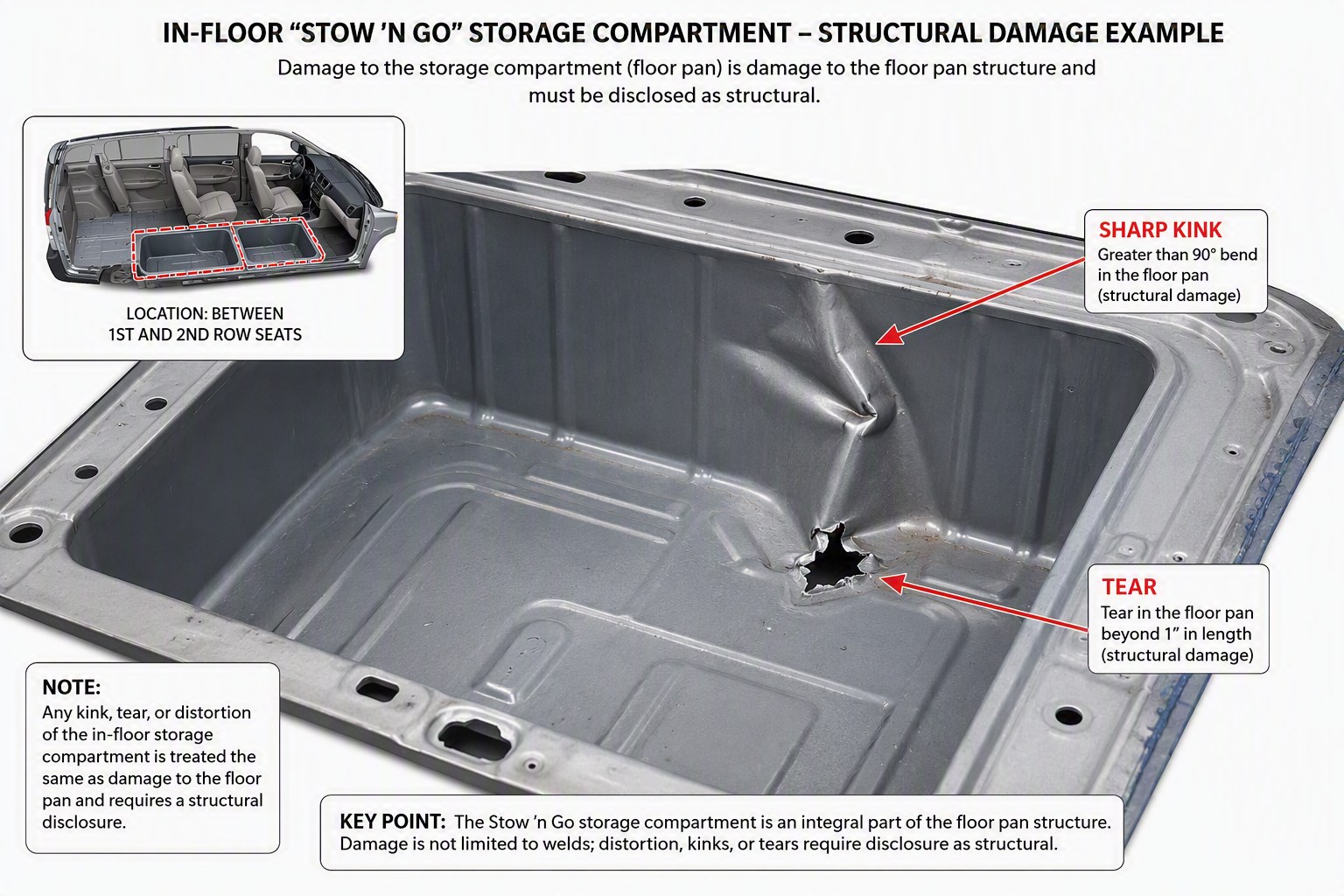
| Floor / Trunk PanelsStow ’n Go: on Pacifica, Town & Country, and Grand Caravan the in-floor compartment is part of the floor pan — kinks, tears 1" or more, and permanent distortion are disclosed on this line. | Tears 1" or More, Existing Permanent Damage, Removed, Modified, Repaired or Replaced Panels | Tears 1" or More, Existing Permanent Damage, Removed, Modified, Repaired or Replaced Panels | N/A |
| Quarter* or Cab* Panel | Replacement Only | Replacement Only | Replacement Only |
| Inner Quarter Panel Assembly | Existing Permanent Damage, Removed, Modified, Repaired or Replaced | Existing Permanent Damage, Removed, Modified, Repaired or Replaced | N/A |
Note: * Only applies to components deemed structural per the vehicle manufacturer.
Tears 1" or more on floor / trunk panels are a required disclosure.
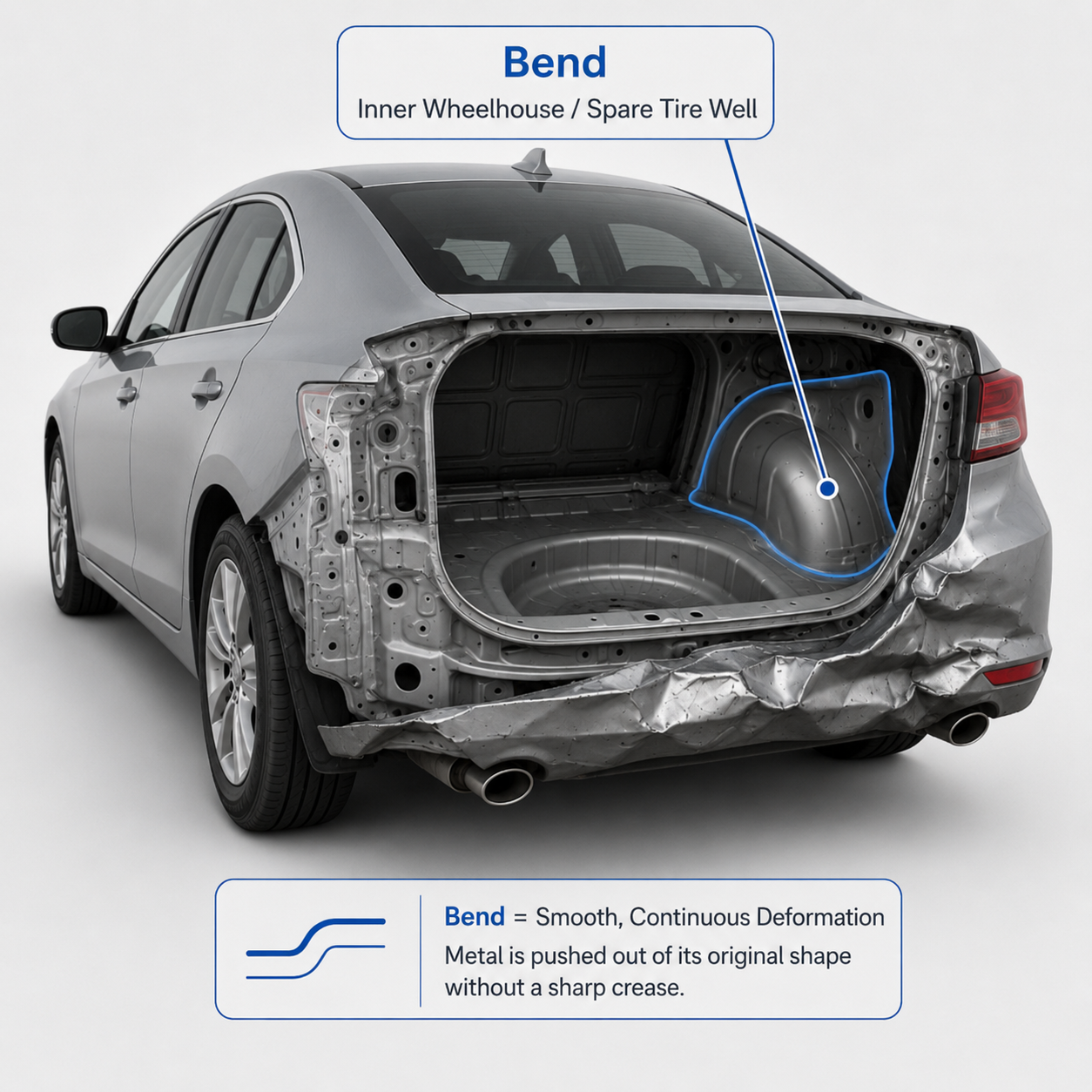
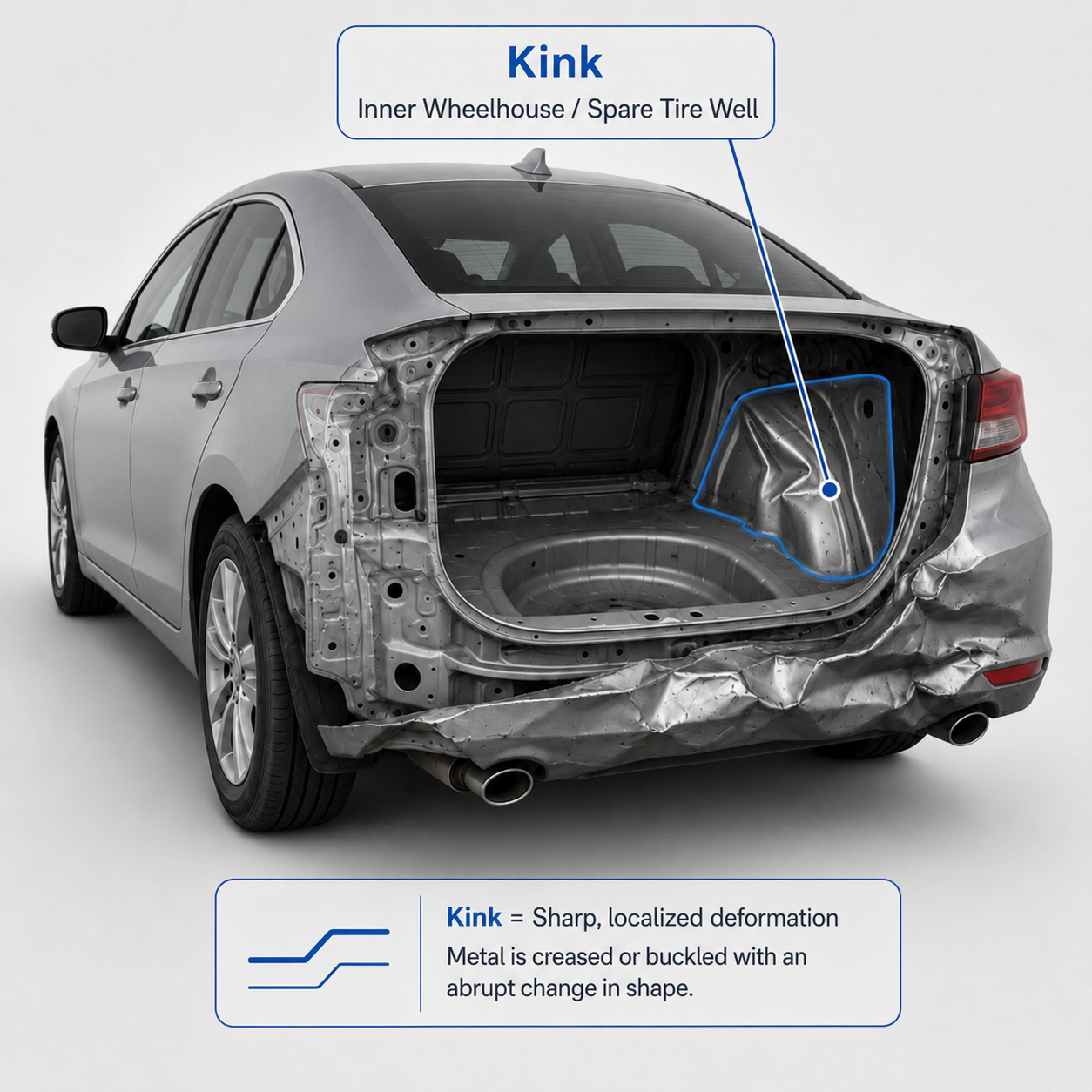
Decide whether deformation on a structural component is a repairable bend or a kink that has to be announced as structural damage.
Definitions
- •Bend: metal pushed out of shape smoothly and continuously; it can normally be straightened.
- •Kink: a sharp bend, typically over 90 degrees across a short distance, or permanent deformation that will not return to shape without excessive heat.
- •Kinked parts are typically replaced rather than repaired.
What triggers the announcement
- •Kinked structural component — announce Structural Damage.
- •Replacement-only component that gets replaced because it is kinked — the replacement triggers the announcement.
- •Floor and trunk panels — a tear of 1 inch or more is disclosable on its own.
- •Smooth bend on a repairable structural component — repair and document, no structural announcement.
Inspection habits
- •Follow the force outward from the point of impact.
- •Look for broken coating or corrosion sitting inside a depression.
- •Check what sits behind the panel — the inner panel is often full disclosure.
- •Composite and carbon components: broken or permanently deformed substrate is treated as a kink.
Decision flow
- 1Identify the vehicle structure type: unibody, unibody on frame (combo), or conventional.
- 2Identify the damaged component and confirm it is structural for that structure type on the matrix.
- 3Metal or composite? Composite with a broken or permanently deformed substrate is treated as kinked.
- 4Is the coating broken or is there corrosion in a depression?
- 5Is the damage permanent — unrepairable without excessive heat? If yes, it is kinked.
- 6Otherwise, is the bend smooth and continuous? Smooth equals bend; abrupt equals kink.
- 7Record the outcome on the condition report and disclose when required.
A kink is permanent. If the metal cannot return to shape without excessive heat, call it kinked and disclose.
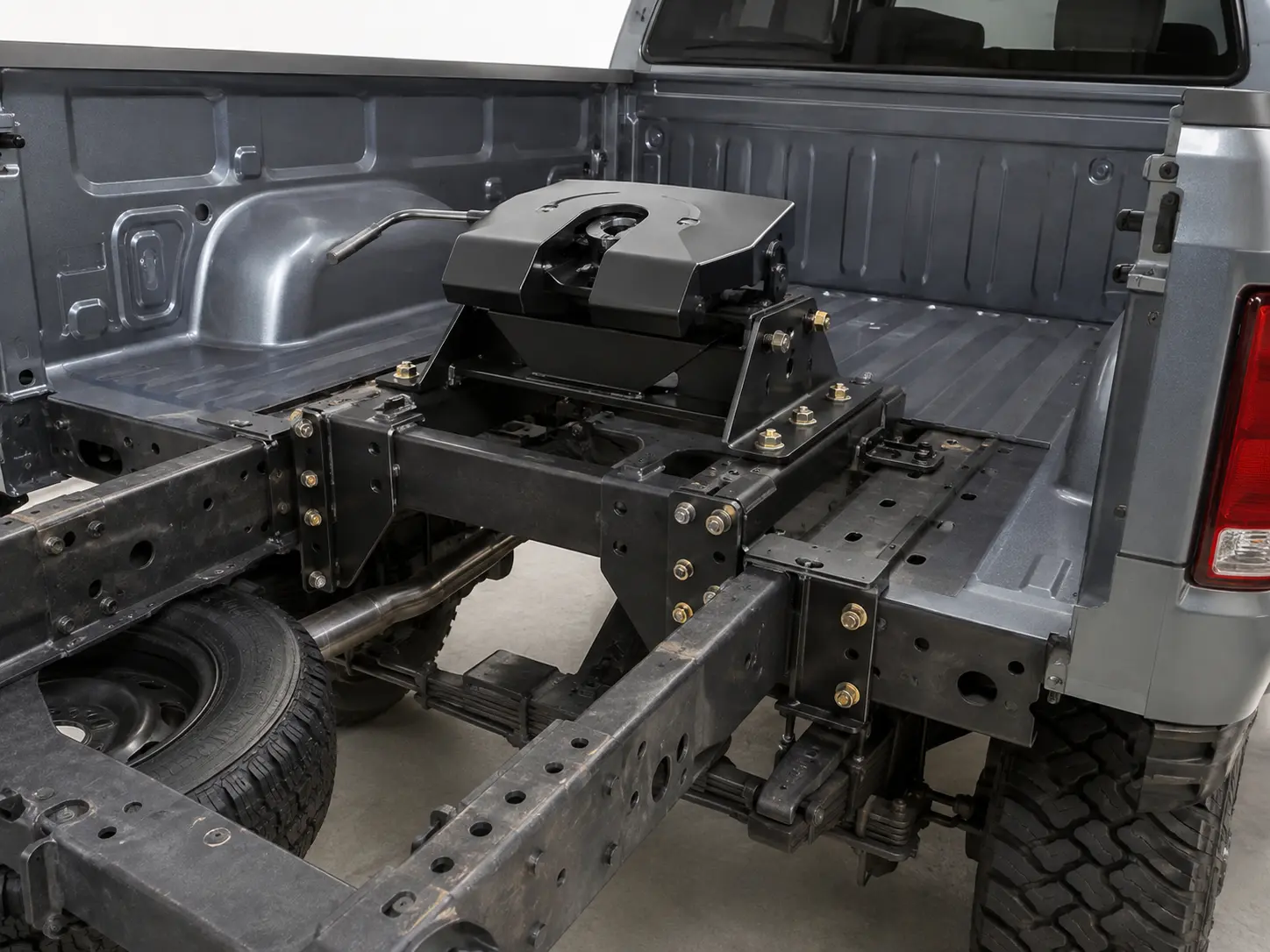
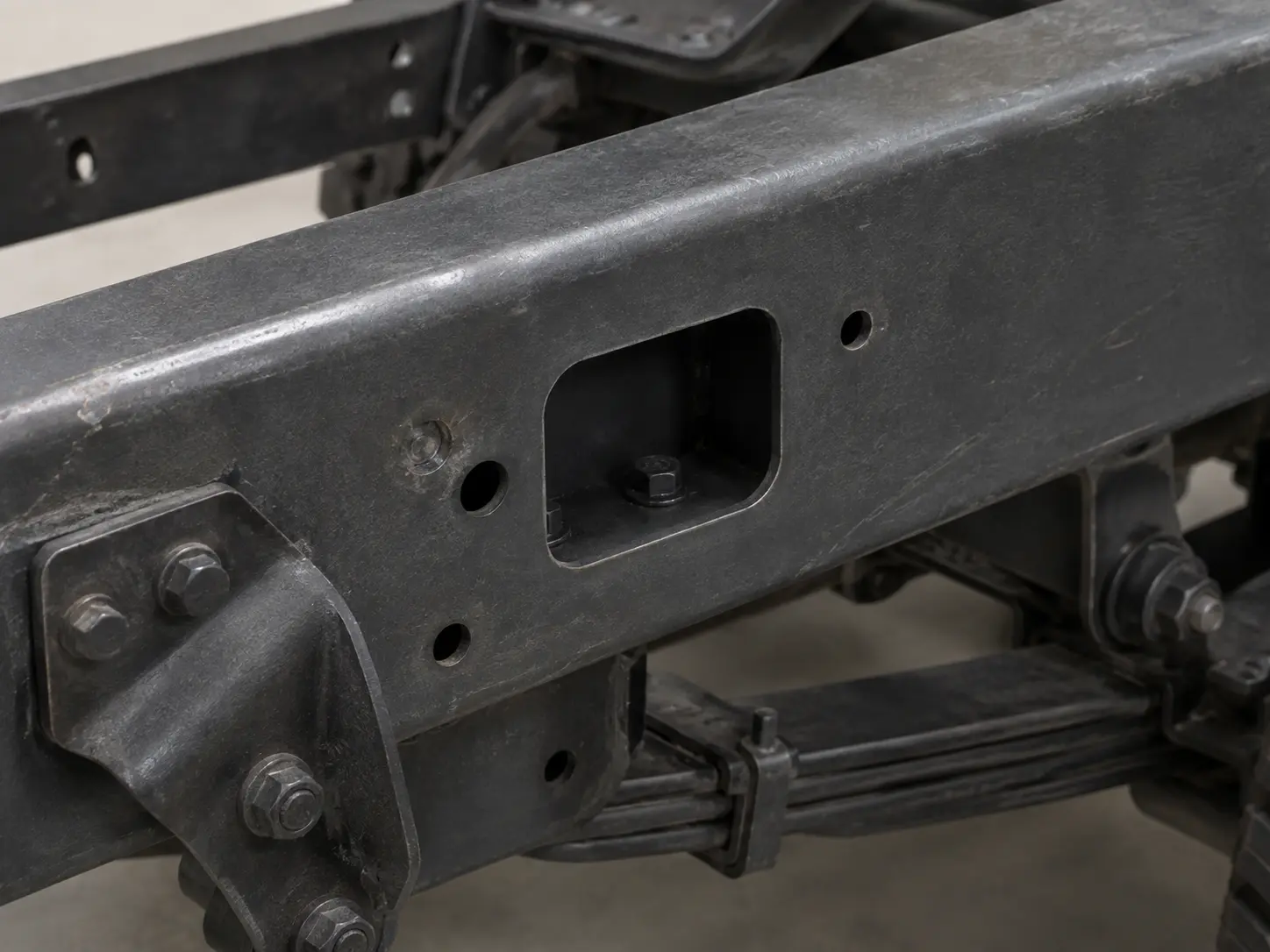
Determine whether an aftermarket modification altered a structural component in a way that requires a structural alteration announcement.
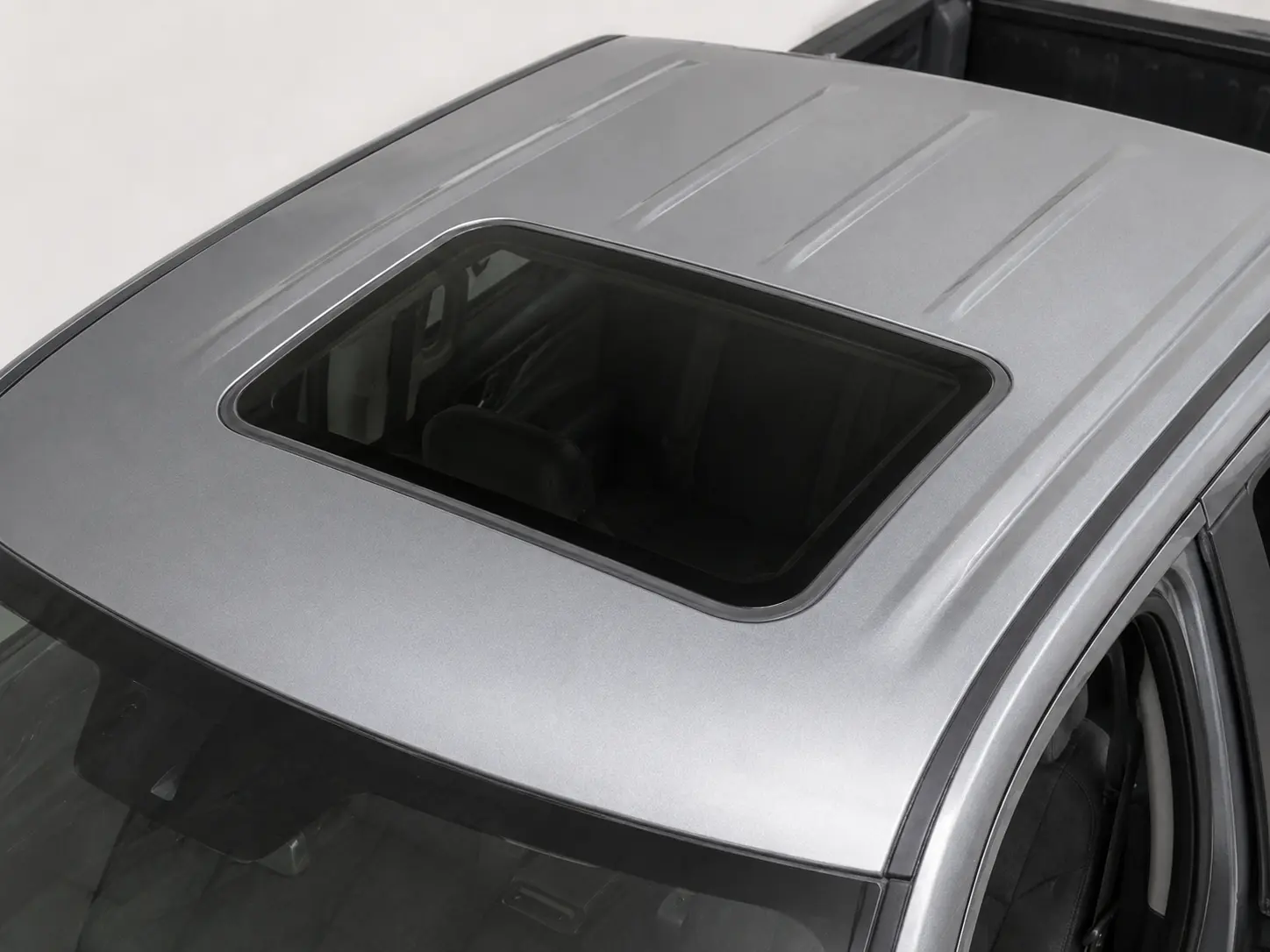
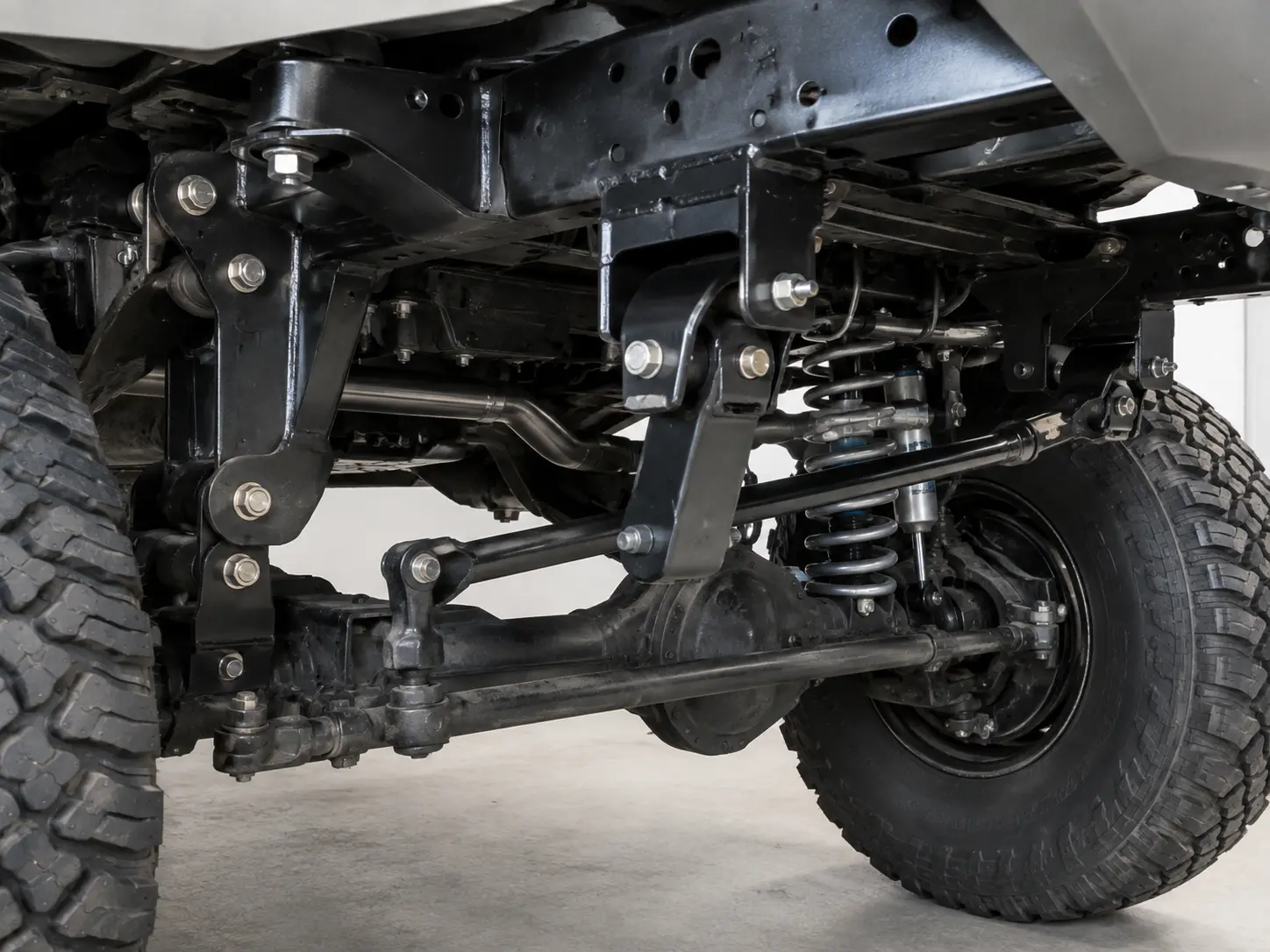
Common modifications to check
- •Towing and hauling: trailering package, 5th wheel, gooseneck, utility bumper.
- •Bolt-on work: snowplow, pushbar, rollbar, side or step bar.
- •Openings: sun or moonroof, access holes, other cut openings.
- •Chassis work: lengthened or shortened frame, suspension lift or lowering, pillar bracing.
Unsafe or substandard triggers
- •Access holes outside policy limits.
- •New holes drilled for bolts that were not there from the factory.
- •Born-with holes elongated or enlarged.
- •Welds made to the structure to mount the modification.
- •Structural components missing, cut, or sectioned to fit the modification.
How to call it
- •Using an existing factory hole with factory hardware is not an alteration.
- •If the altered part is not structural for that structure type, no structural announcement is needed.
- •If a structural component was altered unsafely or substandardly, announce Structural Alteration.
- •Photograph the mounting points, welds, and any cut or enlarged holes.
Decision flow
- 1Identify the vehicle structure type.
- 2Identify the modification that was installed.
- 3Identify which component the modification attaches to or passes through.
- 4Confirm on the matrix whether that component is structural for this structure type.
- 5Check the unsafe or substandard triggers — holes, welds, missing or cut structure.
- 6Announce Structural Alteration when a structural component was altered; otherwise record and move on.
Bolting to factory holes is fine. Drilling, enlarging, welding, or cutting structure is what turns a modification into a structural alteration.
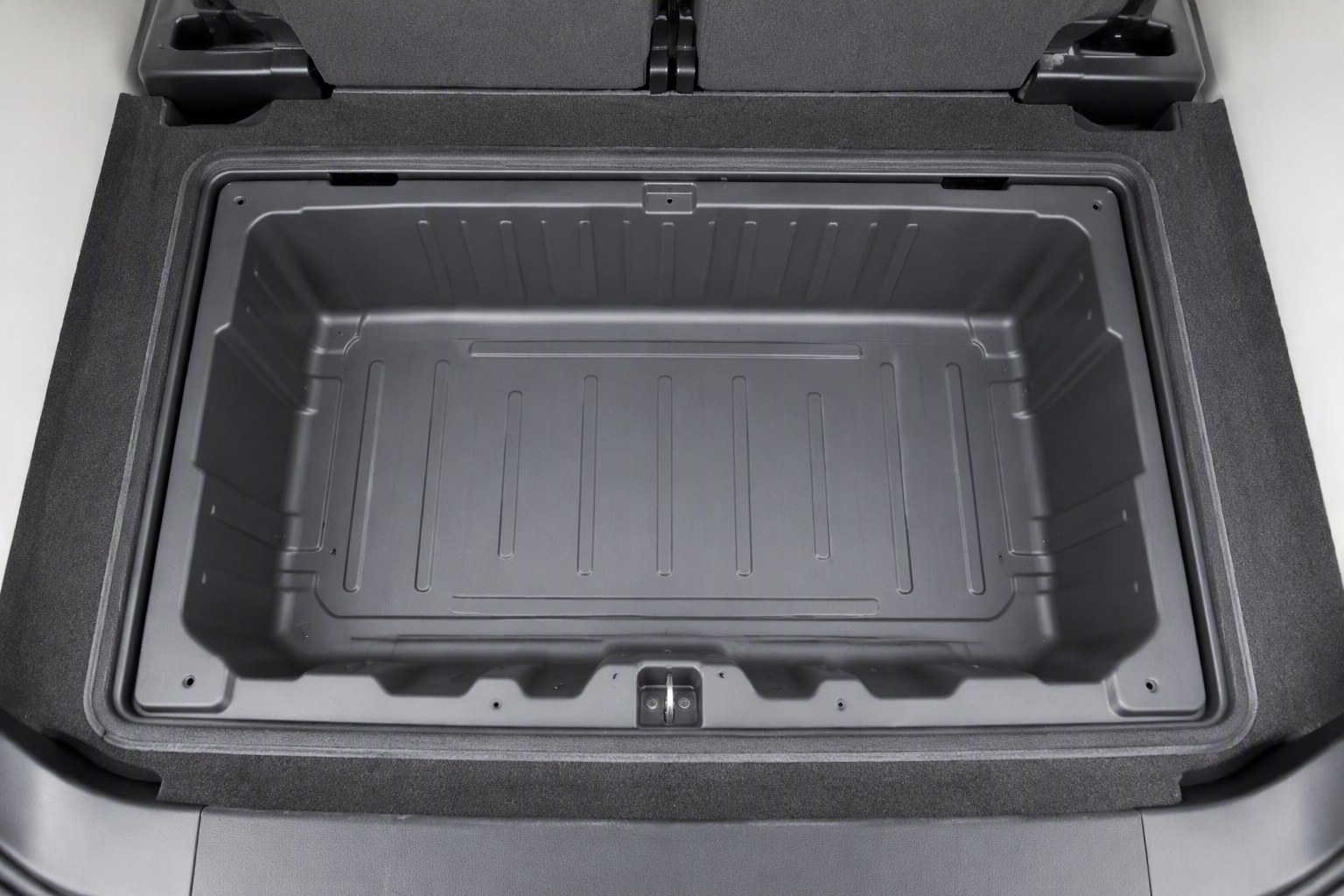
The in-floor Stow ’n Go compartment is part of the vehicle floor pan. When it is kinked, torn 1" or more, or permanently distorted, it must be disclosed as structural damage.
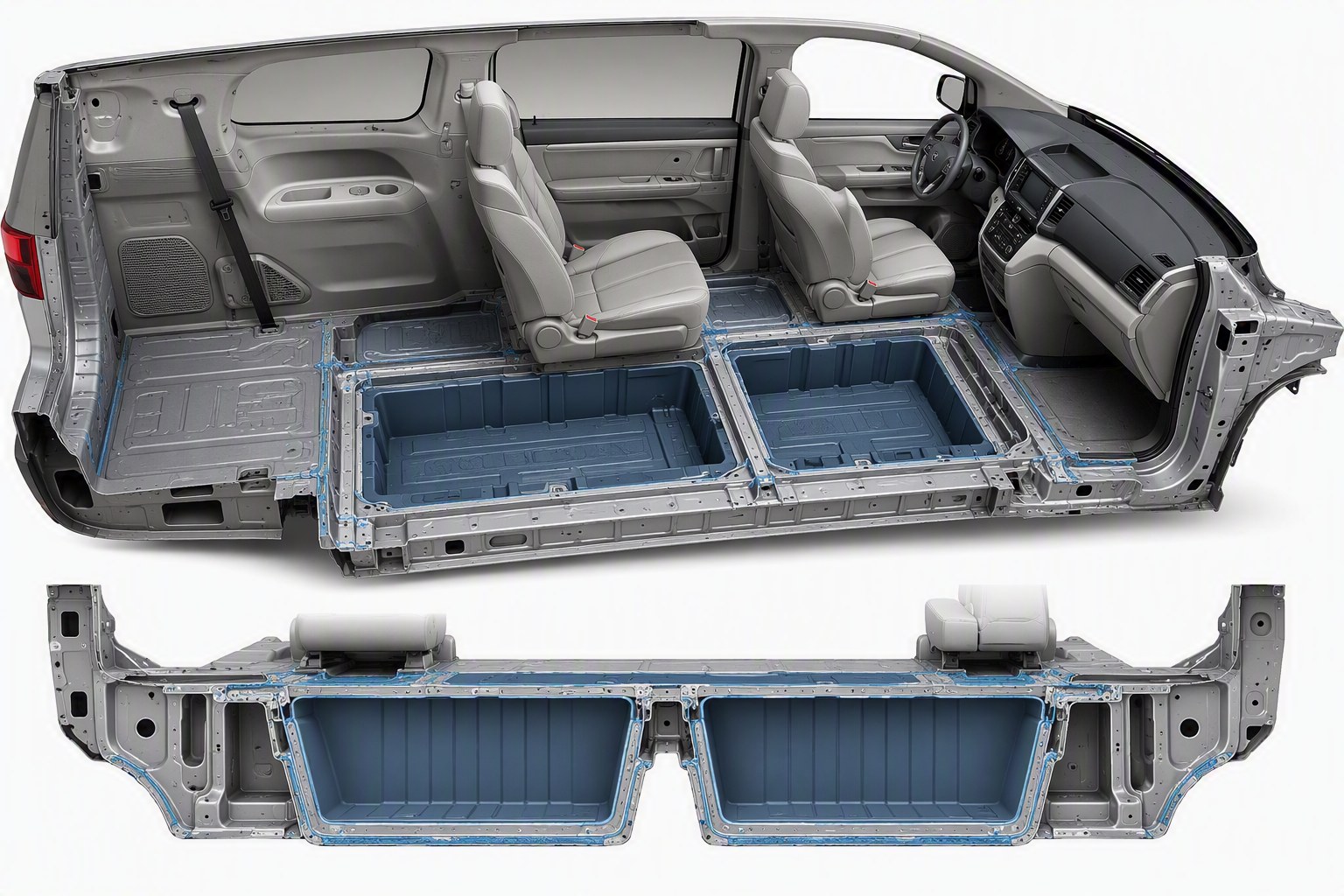
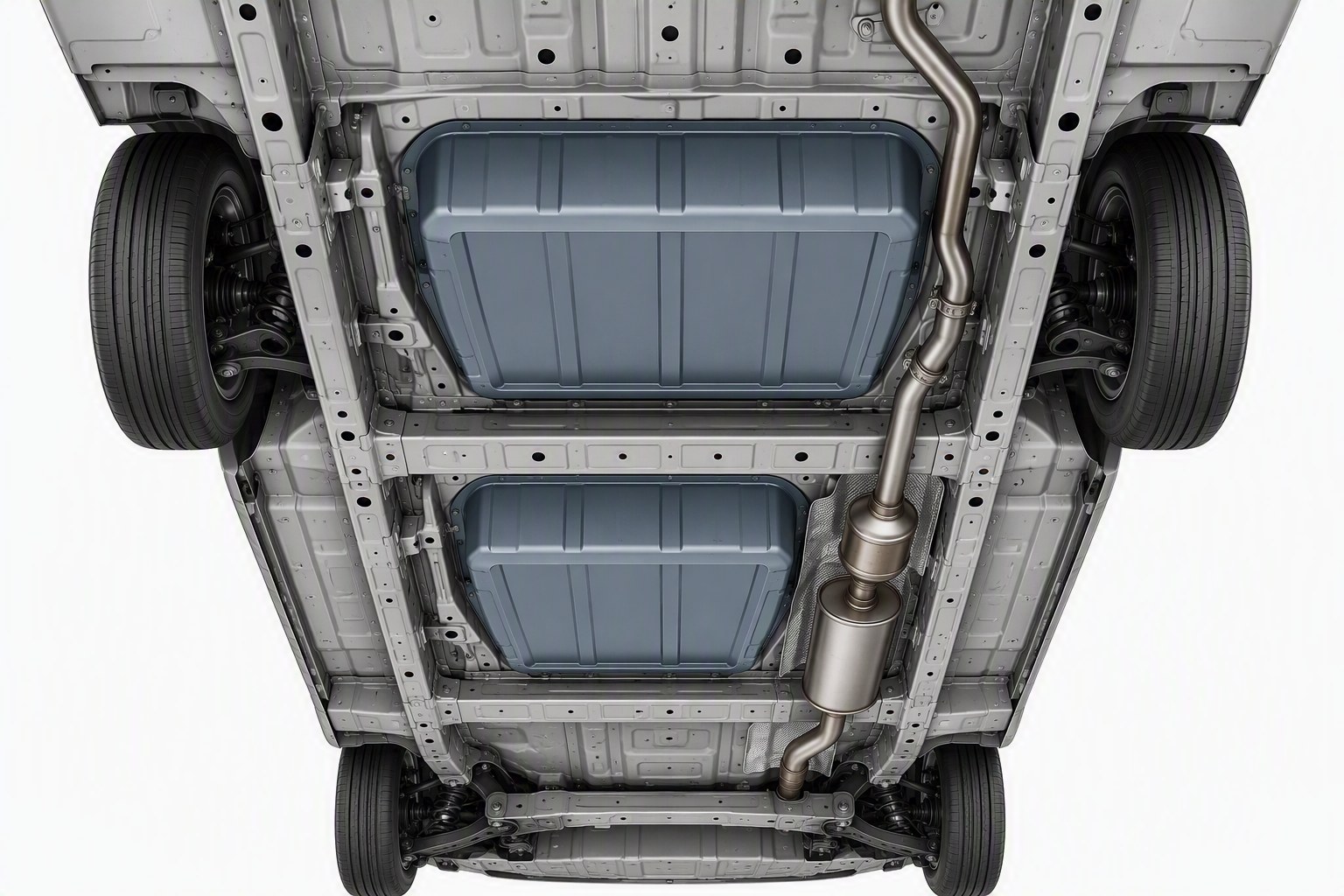
Vehicles with in-floor bins
- •Chrysler Pacifica — includes the spare-tire well and trunk floor.
- •Chrysler Town & Country — bins between row one and row two.
- •Dodge Grand Caravan — bins between row one and row two.
Policy basis
- •Floor / trunk pan: permanent damage, modification, or tears of 1" or more must be disclosed as structural.
- •Any tear greater than 1", including transport tie-down tears, is a required disclosure.
- •Kinked components — a sharp bend or permanent deformation that will not return to shape without excessive heat — are structural and typically replaced.
Key notes
- •Welded vs. glued-on does not matter — if it is a steel floor, it is structural. There is no glued-on exception.
- •The correct term for the assembly method is a structural panel bond, not glue.
- •The compartment IS a structural component unless the OEM factory documents that it is not.
- •If the OEM identifies the part as a floor pan, treat it as a floor pan for disclosure.
- •FCA / Stellantis charges undercarriage and Stow ’n Go storage container damage as full replacement parts, repair, and installation — reinforcing that it is treated as structure, not trim.
Decision flow
- 1Confirm the vehicle: Pacifica, Town & Country, or Grand Caravan with in-floor bins.
- 2Assess for permanent damage — kinks, tears (measure start and stop; 1" or more is disclosable), or distortion that will not return to shape.
- 3Call it structural. Enter it on the Floor / Trunk Pan line; if that line does not check the structural box, use the Parcel Shelf Support line to trigger the announcement.
- 4Photograph the kink, tear, or distortion for the condition report.
- 5Do not exempt for glued-on construction — only OEM factory documentation stating the part is non-structural changes the call.
The in-floor compartment is part of the floor pan. Treat it as structural unless OEM factory documentation says otherwise.